
Strengthening food security in JS-SEZ
Two analysts have called upon Malaysia and Singapore to strengthen food security within the Johor-Singapore Special Economic Zone (JS-SEZ)
This is especially so since food security is one of the 11 focal sectors in the zone.
“To maximise the potential for food security, the JS-SEZ comprehensive blueprint must contain provisions to promote the agrifood sector,” wrote Elyssa Kaur Ludher and Angaindrankumar Gnanasagaran in an article, A food security imperative for the Johor – Singapore SEZ Blueprint that was published in Singapore’s Fulcrum.
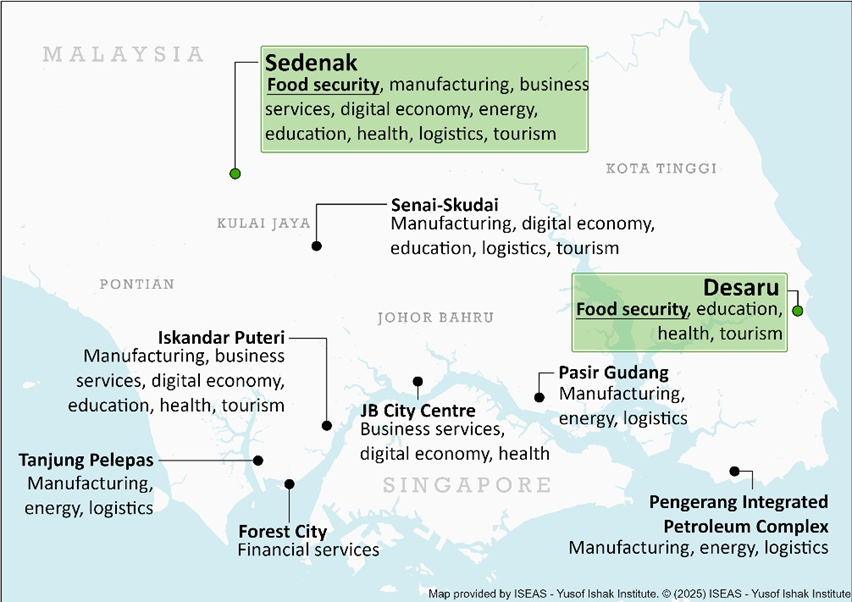
They have also earmarked two areas specifically for food security.
One is Sedenak and the other, Desaru.
“The SEZ spans over 3,500 square kilometres, four times the size of Singapore. Of its districts, food sector development has been earmarked for Desaru, where 60 per cent of land will be dedicated to agriculture, and Sedenak (currently dominated by palm oil plantations).
“The coastal zone of Pontian, which already houses more than 8,000 kelongs of prawn, tilapia and grouper, is another possible development area. Yet there is no incentive for agri-food businesses to be limited to these areas; farms and food businesses have been setting up anywhere costs are competitive.”
The four measures
The following are the measures that needs to be taken.
First, the establishment of ‘food security hubs’: the JS‑SEZ could host a multi‐stakeholder hub to co‐locate farmers (smallholders and larger producers), cooperatives, government bodies, R&D institutions, logistics providers, and private investors.
It could draw inspiration from other agro-hubs like the Netherlands’ Foodvalley or Vietnam’s Food Innovation Hub. Such a hub would centralise procurement, mechanisation, post‐harvest handling, crop management, and traceability services, to enhance productivity, reduce waste, and ensure consistent surpluses for strategic stockpiling.
Second, the Blueprint can include agricultural incentives and equity schemes. While Johor’s State Agro-Food Policy (DANJo) is promoting agricultural modernisation and technology proliferation, this needs to be complemented by farmer-centred incentive schemes.
When farmers are rewarded for higher yields or sustainable practices, they have a stronger incentive to invest in their crops, making it more likely they will attract the private capital they need to scale up.
Schemes, such as a shared equity structure, could be introduced to attract serious farmers by encouraging them to hold ownership stakes alongside public and private partners. This would align the interests of all players towards sustained growth.
Third, the Blueprint can prioritise research partnerships and skills development across the border. Johor- and Singapore-based research institutes could accelerate innovation in climate-resilient agriculture and build future agri-leadership capacity, including for the region.
Siting talent development programmes in universities and technical colleges could attract the human resources needed for the JS-SEZ’s growth.
Finally, the establishment of bio-secure zones (areas with enhanced measures to prevent the introduction and spread of diseases or pests) in the JS-SEZ that are aligned with the World Organisation for Animal Health’s (WOAH) standards could mitigate the risks of zoonotic disease outbreaks and enable continued production and trade even amid epidemiological disruptions.