
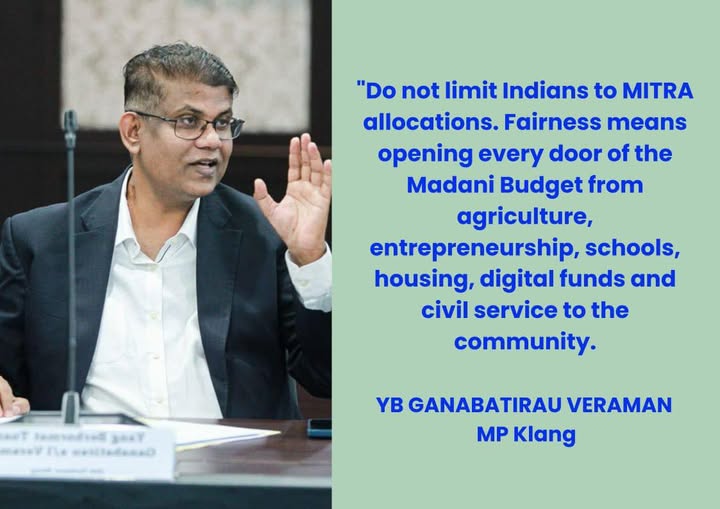
Madani benefits must reach grassroots Indians
BY: V GANABATIRAU
The Madani Government has outlined a vision of compassion, inclusivity and fairness for all Malaysians. As a Member of Parliament, I support this vision. But I also carry the responsibility of asking: how much of these benefits have actually reached the grassroots Indian community?
The 2025 Budget is filled with promising initiatives. RM200 million has been allocated under the Agrofood Value Chain Modernisation Grant to help small farmers and agro-preneurs. RM330 million has been channelled to TEKUN financing, including special allocations for women and youth. There are funds for digital economy transformation and artificial intelligence to prepare Malaysians for Industry 4.0. RM6.8 billion is set aside for TVET training, RM1.9 billion for school upgrades including vernacular schools, and more for housing schemes and civil service recruitment.
All these are commendable. But the Indian community deserves transparency. How many Indian smallholders have benefited from the agro-food grants? How many Indian youth and startups have been included in digital and AI funds? From TEKUN, how many Indian entrepreneurs, especially small traders and women, were approved?
Education is another pressing concern. Budget allocations are announced for schools, but how much has flowed directly into Tamil schools? Many still struggle with basic infrastructure, overcrowded classrooms and limited resources. We must see real progress, not just promises.
Civil service recruitment also needs scrutiny. We cannot confuse professional training intakes such as medical, pharmacy and dentistry students with actual appointments in the civil service. What matters is how many Indians are recruited into the Pengurusan dan Profesional (P&P), and Kumpulan Pelaksana levels. Without this, the civil service will remain unbalanced and unrepresentative of the country’s diversity.
Too often, the government points to MITRA whenever the Indian community is raised. MITRA is important, but it should not be treated as the sole solution. Indians are not a special project to be confined to one agency.
This has been the mistake for decades. Every year during the budget debate, Indians are directed towards MITRA allocations as if that is the beginning and end of government support. This approach has two damaging effects. It boxes Indians into a separate compartment, cutting them off from mainstream programmes in agriculture, entrepreneurship, housing, and education. It also creates a false perception that Indians are already taken care of simply because MITRA exists, when in reality its allocations are only a fraction of what is available in the larger budget.
The national budget runs into hundreds of billions. Indians must have fair access to these mainstream allocations, not just a fraction through MITRA. Reducing Indian development solely to MITRA sidelines the community, narrows opportunities, and reinforces dependency.
MITRA’s role should therefore be redefined. It should focus on capacity building, leadership and skills development, scholarships, cultural programmes, and empowerment of NGOs. It should act as a bridge to connect Indians with wider government opportunities. But it cannot replace rightful access to the national budget in agriculture, digitalisation, TVET, housing, healthcare, and civil service recruitment.
This is not about asking for special treatment. It is about fairness and accountability. The government must publish disaggregated data. How many Indians received agricultural and TEKUN grants? How many benefited from digital funds? How much of the school allocation reached Tamil schools? How many Indians were recruited into the civil service at P&P and Kumpulan Pelaksana levels?
Only then can we show that the Madani framework is truly inclusive. Only then will the Indian grassroots, estate workers, small farmers, Tamil school students, graduates and entrepreneurs feel that they are part of Malaysia’s journey forward.
V GANABATIRAU is Klang MP and Selangor DAP vice chairman.