
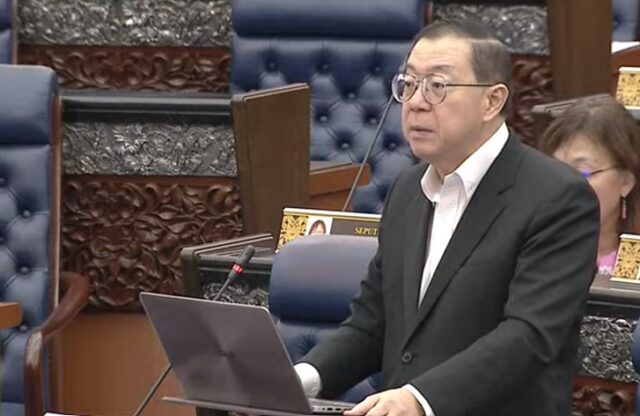
‘Establish special task force on tariff crisis for the affected MSME sector’
Lim Guan Eng (PH-Bagan) has called upon the government to establish a special task force on tariff crisis since the US imposed reciprocal tariffs at 19% affected the micro, small, medium enterprise (MSME) sector that represented 39.5% of Malaysia’s gross domestic product (GDP).
“I would like to propose the establishment of a Special Tariff Crisis Task Force for MSMEs affected directly or indirectly, with the following seven terms of reference:
- Ensure that MSMEs continue to receive orders and business opportunities (including mandating the purchase of local goods by both domestic and foreign investors and contractors);
- Prevent the influx of foreign goods that could close off the market for MSME products;
- Control rising costs by reducing the risks and impacts of tax exposure or new policy regulations;
- Address the shortage of workers or difficulties in obtaining approval for foreign workers;
- Introduce monetary measures such as further lowering interest rates to stimulate economic development, especially by relying on the domestic market to replace the lost U.S. market;
- Implement fiscal measures such as outlining financial aid and subsidies for critical sectors; and
- Explore new foreign markets.
He raised this issue while debating the Budget 2026 at committee stage in Dewan Rakyat.
Lim also highlighted the vitality of the MSME sector.
“There are 1,086,380 Micro, Small and Medium Enterprises (MSMEs) in Malaysia, accounting for 96.1% of all businesses in the country.
“In 2024, MSMEs generated 48.7% of total employment or 8.1 million workers in Malaysia, contributed 14.3% of Malaysia’s total exports amounting to RM197 billion, and represented 39.5% of GDP, equivalent to an added value of RM652.4 billion, marking an increase of 5.8% compared to the previous year.”
Lim acknowledged that the MSME sector growth is 5.8% which is higher than the GDP growth at 5.1% but cautioned that the positive figures were achieved before the US imposed reciprocal tariffs.
“It is highly likely that these positive economic indicators will not be repeated this year with the implementation of the reciprocal tariffs. This is evident from the weakening business orders, as many MSMEs are beginning to doubt their survival beyond mid-2026, when the full impact of the tariff war will be felt.
“The weakened business order situation is reflected in Malaysia’s manufacturing sector, which showed signs of reduced activity in October 2025. The latest Malaysia Purchasing Managers’ Index (PMI) by S&P Global recorded 49.5, down from 49.8 in September. The reading of 49.5 in October is the lowest in four months.
“This indicates a softening business environment. According to S&P Global, the decline was due to weak new order inflows, resulting in reduced output volumes. Although cost control remains an important factor, good cost management means little without new business orders.”