
Umno at the Edge: Running out of Malays, time and excuse
Dr Ahmad Zaharuddin Sani
Umno’s latest general assembly was theatrical, not transformative. The banners were bright, the chants familiar, and the speeches polished — but the performance could not hide the rot. This was not a party plotting a comeback; it was a party rehearsing its own eulogy. Malaysia has moved on. Umno has not. The real crisis is not merely electoral decline; it is existential irrelevance.
The New Reality Umno Refuses to See
Umno still speaks as if the country is the Malaysia of the 1980s: hierarchical, patronage-driven, and defined by rigid ethnic fault lines. That Malaysia is gone. Cities have changed the social contract. Young Malaysians live in plural social worlds — online, cosmopolitan, and issue-driven. They care about jobs, housing, corruption, climate, and dignity. They do not want to be reduced to a demographic to be managed.
Umno’s failure is simple and brutal: it keeps offering the same old menu while the diners have left the restaurant.
Akmal and the Youth: A Warning Shot, Not a Rebellion
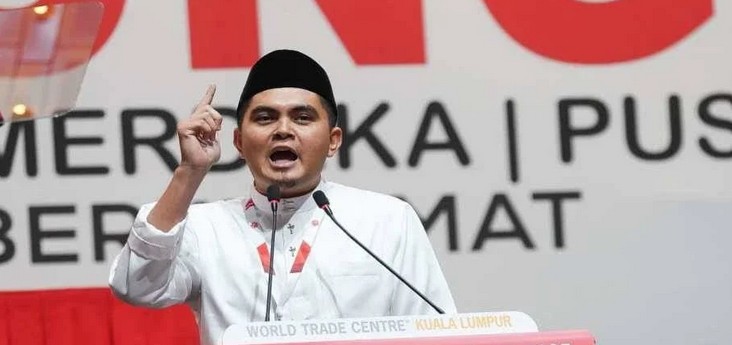
Dr. Muhamad Akmal Saleh’s voice is the clearest alarm bell. He is not the problem; he is the symptom. His anger and impatience are the language of a generation that no longer trusts the party to secure their future. Young Malays are migrating to Perikatan Nasional in some places, to urban apathy in others, and to issue-based politics everywhere else. They are not waiting for Umno to catch up.
Umno’s elders treat youth restlessness as noise. That is a fatal misread. Silence the youth and you silence your future. A party that cannot recruit its next generation of voters is not merely losing elections — it is dying slowly, politely, and irreversibly.
Najib: Addiction, Not Loyalty
The Najib question is not a legal or personal matter alone; it is a mirror. The party’s obsession with his pardon reveals an addiction to a political model that no longer works: money politics, patronage, and centralized authority. Najib is both the high watermark of Umno’s power and the symbol of its moral collapse. Clinging to him is not loyalty; it is a refusal to reckon.
Umno cannot credibly promise reform, integrity, or competence while treating the architect of its fall as a cause célèbre. The party’s inability to exorcise this ghost tells voters everything they need to know about UMNO’s appetite for change.
The DAP Marriage: Convenience, Not Conviction
Umno’s uneasy partnership with DAP in the unity government is the political equivalent of a shotgun marriage. It was born of panic, not principle. That makes it brittle. The leadership can sign agreements in Putrajaya, but it cannot legislate love into the grassroots.
The contradiction is stark: for decades Umno warned Malays of DAP’s threat; now it asks Malays to accept DAP as a partner. The result is cognitive dissonance among Umno’s base and strategic paralysis at the top. Embrace DAP too tightly and you hemorrhage Malay support; resist it too loudly and you destabilize the coalition. Umno is stuck between two fires and, worse, seems unable to choose a direction that rebuilds trust.
Malay Unity Dreams: Muafakat Nasional Reheated
Talk of a “grand Malay collaboration”, Umno, PAS, Bersatu and assorted Malay figures, is the party’s fallback fantasy. It is Muafakat Nasional reheated and served cold. The pitch is simple: consolidate Malay votes by re-ethnicising politics. The danger is equally simple: it trades national relevance for short-term tribal gains.
A Malay-only bloc may win seats in the short term, but it will fracture the country’s fragile plural compact, spook investors, and push moderates away. It will also fail to capture the imagination of Melayu muda, who are more likely to be influenced by global culture, digital networks, and economic anxieties than by nostalgic appeals to ethnic solidarity.
If Umno’s answer to irrelevance is to double down on ethnic exclusivity, it will accelerate its own marginalisation.
The Race Card: From Strategy to Confession
Once, the race card was a tool. Now it is a confession: “We have nothing else to offer.” Every time Umno reaches for ethnic fear, it reveals the emptiness of its policy cupboard. Race politics still moves votes in pockets, but it does not build a governing majority in a Malaysia that is urbanising, diversifying, and digitally literate.
Playing the race card is not a strategy; it is a surrender. It signals to voters, Malay and non Malay, that Umno has run out of ideas, competence, and imagination.
What Malaysians Want — And What Umno Refuses to Deliver
If Umno wants to matter again, it must stop asking how to protect Malays and start asking how to prepare Malays for the future. The electorate — across ethnic lines — wants three things:
• Integrity instead of drama. Clean governance, not spectacle.
• Competence instead of nostalgia. Policies that deliver jobs, housing, and opportunity.
• Future-oriented politics instead of racial replays. A vision that equips citizens for a globalised economy.
Umno’s current playbook delivers none of these. It offers identity politics, patronage, and nostalgia. That is a losing combination in 2026.
A Roadmap for Reinvention (If Umno Has the Courage)
Reinvention is possible, but it requires brutal honesty and structural change:
- Purge the addiction to patronage. Real reform means dismantling the networks that reward loyalty over competence.
- Embrace generational leadership. Give youth real power, not token positions. Let them shape policy, not just slogans.
- Reframe Malay leadership as capability-building. Shift from protection to empowerment: education, entrepreneurship, and digital skills.
- Make integrity the brand. Publicly commit to anti-corruption measures with independent oversight.
- Choose coalition clarity. Decide whether UMNO is a coalition stabiliser or a disruptor and act accordingly.
None of this is easy. That is the point. Reinvention is costly. So is irrelevance.
Final Word: Reinvention or Museum Piece
Umno stands at a cliff. One step forward, painful, honest, and reforming, could salvage a role in Malaysia’s future. One step back, nostalgic, defensive, and ethnically narrow will consign it to the museum of Malaysian politics.
The country is watching. The youth are judging. The markets are calculating. The question is not whether Umno can win the next election; it is whether Umno can survive the next decade as a living political force or become a relic of a political era that has passed. If Umno chooses nostalgia, it will not be history’s victor. It will be its exhibit.
Dr Ahmad Zaharuddin Sani is a political analyst at Global Asia Consulting