
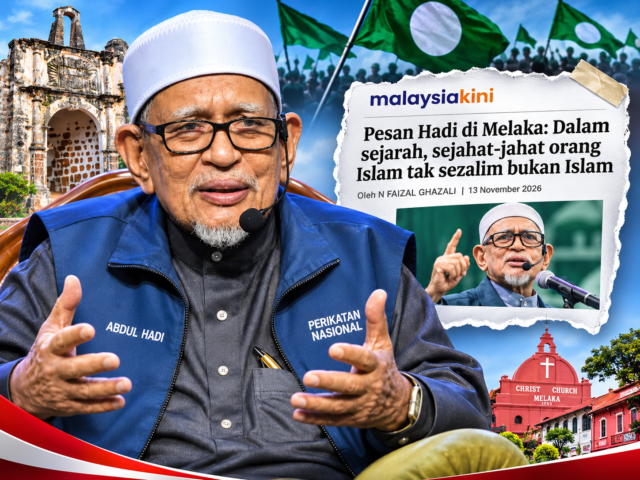
Hadi did make the statement that even the worst Muslim rulers are less oppressive than non-Muslims, not a media fabrication
Pas president Tan Sri Abdul Hadi Awang did make the controversial statement that even the worst Muslim rulers are less oppressive than non-Muslims, as reported by news portal Malaysiakini.
The remarks were made during a Barisan Nasional–Perikatan Nasional (BN–PN) election campaign event in Bukit Katil, Melaka, on the night of November 12, ahead of the Melaka state election.
Malaysiakini quoted Abdul Hadi as saying: “Even the most wicked Muslims, even the worst Muslims governing a country, are not as oppressive as non-Muslims.”
The statement attracted public attention because it appeared to make a sweeping comparison between Muslim and non-Muslim rulers based on their religious identities.
On November 13, the Office of the Pas President issued a media statement expressing regret over Malaysiakini’s reporting, describing it as misleading and claiming that Abdul Hadi’s remarks had been taken out of context.
According to the statement, Abdul Hadi was explaining that Islamic politics is guided by the principles of sin and reward, which are intended to promote just governance and safeguard the rights of non-Muslim communities.
However, the official response did not specifically deny that Abdul Hadi had uttered the words quoted by Malaysiakini. Instead, the objection focused on the context and interpretation of his remarks.
Abdul Hadi’s political secretary, Syahir Sulaiman, also explained that the Pas president was referring to the historical record of Islamic governance.
Nevertheless, the explanation raises a separate question about the historical basis for claiming that even the worst Muslim rulers are necessarily less oppressive than non-Muslim rulers.
History provides examples of both just and oppressive governments across different civilisations, regardless of the religious backgrounds of their leaders.
A categorical comparison of this nature therefore requires substantial historical evidence and clearly defined standards for measuring oppression and justice.
Islamic teachings themselves emphasise justice as a fundamental obligation. Surah Al-Ma’idah, verse 8, instructs believers to uphold justice even when dealing with those they dislike.
The controversy also attracted attention because leaders of parties with predominantly non-Muslim memberships, including MCA president Wee Ka Siong and Gerakan president Dominic Lau, were present and spoke at the same campaign event.
Their participation raised questions about how Abdul Hadi’s remarks should be understood within the context of Pas’s political cooperation with MCA and Gerakan.
More importantly, the controversy highlights the need to distinguish between the accuracy of a reported quotation and the interpretation of its broader meaning.
A news report may accurately reproduce the words spoken by a political leader, while the speaker or their representatives may still dispute whether the quotation adequately reflects the full context.
In this case, the Office of the Pas President challenged Malaysiakini’s interpretation without specifically denying the words attributed to Abdul Hadi.
Any allegation that the news portal fabricated the statement would therefore require evidence showing that the quotation was invented or materially altered.
If Pas maintains that the report misrepresented Abdul Hadi’s intended message, the dispute could be clarified by identifying the relevant portions of the complete speech and explaining how they affect the meaning of the quoted remarks.
At the same time, whether Abdul Hadi’s broader assertion about Muslim and non-Muslim rulers is historically accurate remains a separate question requiring credible evidence.
The central issue is that disputing the context of a statement does not automatically establish that the media fabricated it. Equally, confirming that a statement was made does not establish that the claim itself is factually correct.
Ultimately, justice and oppression must be assessed through a ruler’s conduct, policies and governing record rather than religious identity alone.
READ MORE International media describe Najib as ‘disgraced former PM’ as house arrests makes global headlines