
Adopt relative poverty in MPI, says Selangor lawmaker
In welcoming the call by Economy Minister Akmal Nasir to redefine poverty based on Multidimensional Poverty Index (MPI), Bukit Gasing state assemblyman Rajiv Rishyakaran urged the federal government to recognise and adopt relative poverty as a primary metric alongside the existing absolute poverty metric.
The following are the three reasons why Akmal should adopt relative poverty.
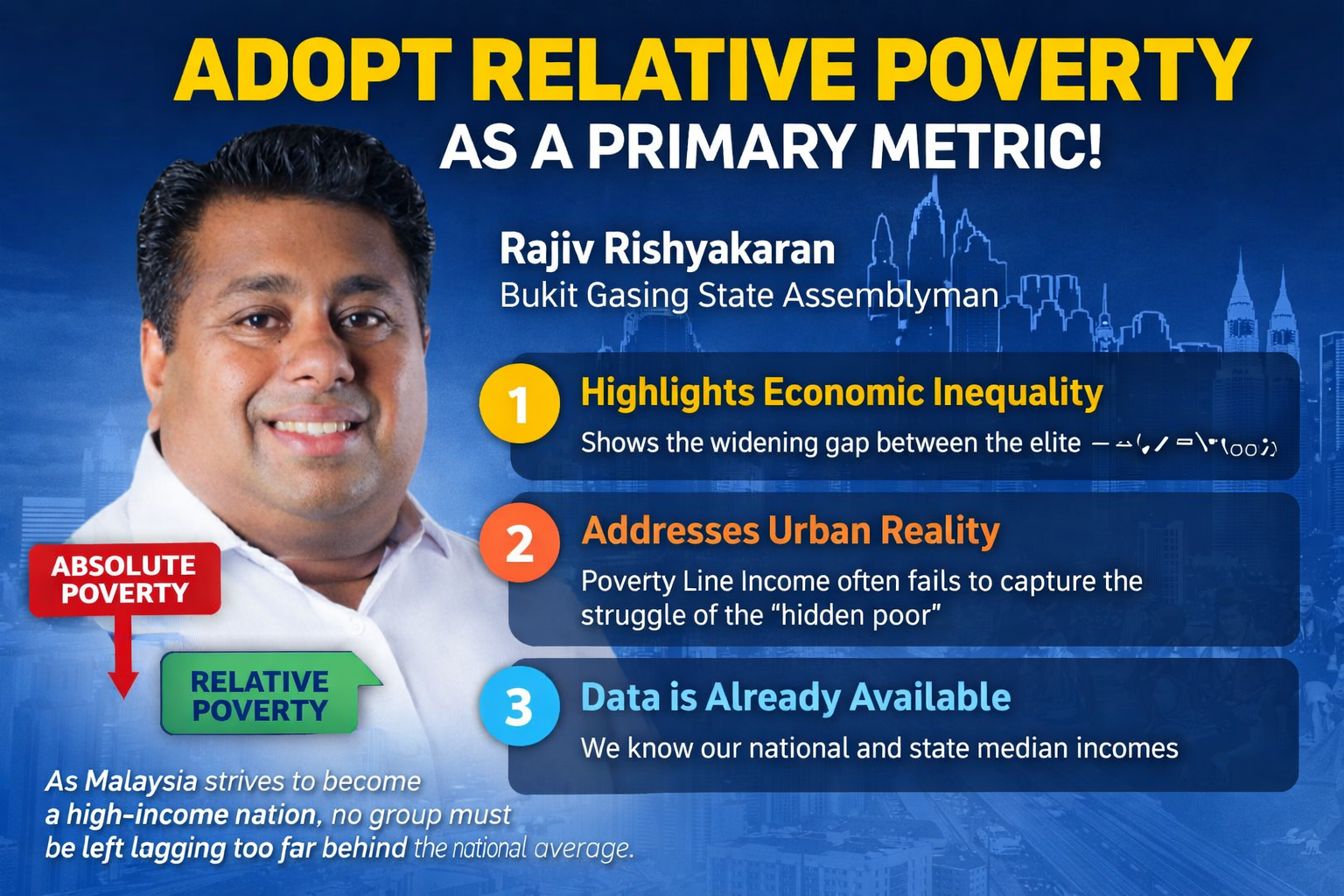
“It reflects economic inequality. Unlike absolute poverty, which only looks at a fixed basket of goods, relative poverty highlights the widening gap between the elite and the working class.
“As Malaysia strives to become a high-income nation, we must ensure that no group is left lagging too far behind the national average,” he said via a statement.
“It addresses the urban reality: In areas like Petaling Jaya, the “Poverty Line Income” often fails to capture the struggle of the “hidden poor”—those who earn above the official poverty line but cannot afford the standard of living required to function in a modern city.
“Recognizing relative poverty provides a more honest assessment of urban hardship.
“Data is already available. Unlike the MPI, which requires new data frameworks, we already have the data for relative poverty. We know our national and state median incomes.
“We can implement this shift overnight to broaden the safety net for the “squeezed” middle and the B40.”
The DAP lawmaker also pointed out the need for a bridge for the present since MPI is a long – term vision.
“I urge the Minister to explain how the government plans to integrate relative poverty metrics into current social assistance programs. We must not let the pursuit of a sophisticated future system delay the urgent need for a more inclusive definition of poverty today.”
He also cautioned the government to be realistic in implementing MPI.
“Transitioning the entire machinery of government—across federal, state, and local levels—to effectively collect, analyze, and act upon multidimensional data is a massive undertaking that is likely many years away from being fully operational.
“Our citizens, especially those in urban constituencies like Bukit Gasing, cannot afford to wait for a perfect system while the cost of living continues to rise.”