
Why IVF Success Depends on More Than Clinics and Technology
By: Dr Adeline Chia and Khairunnisa’ Esa
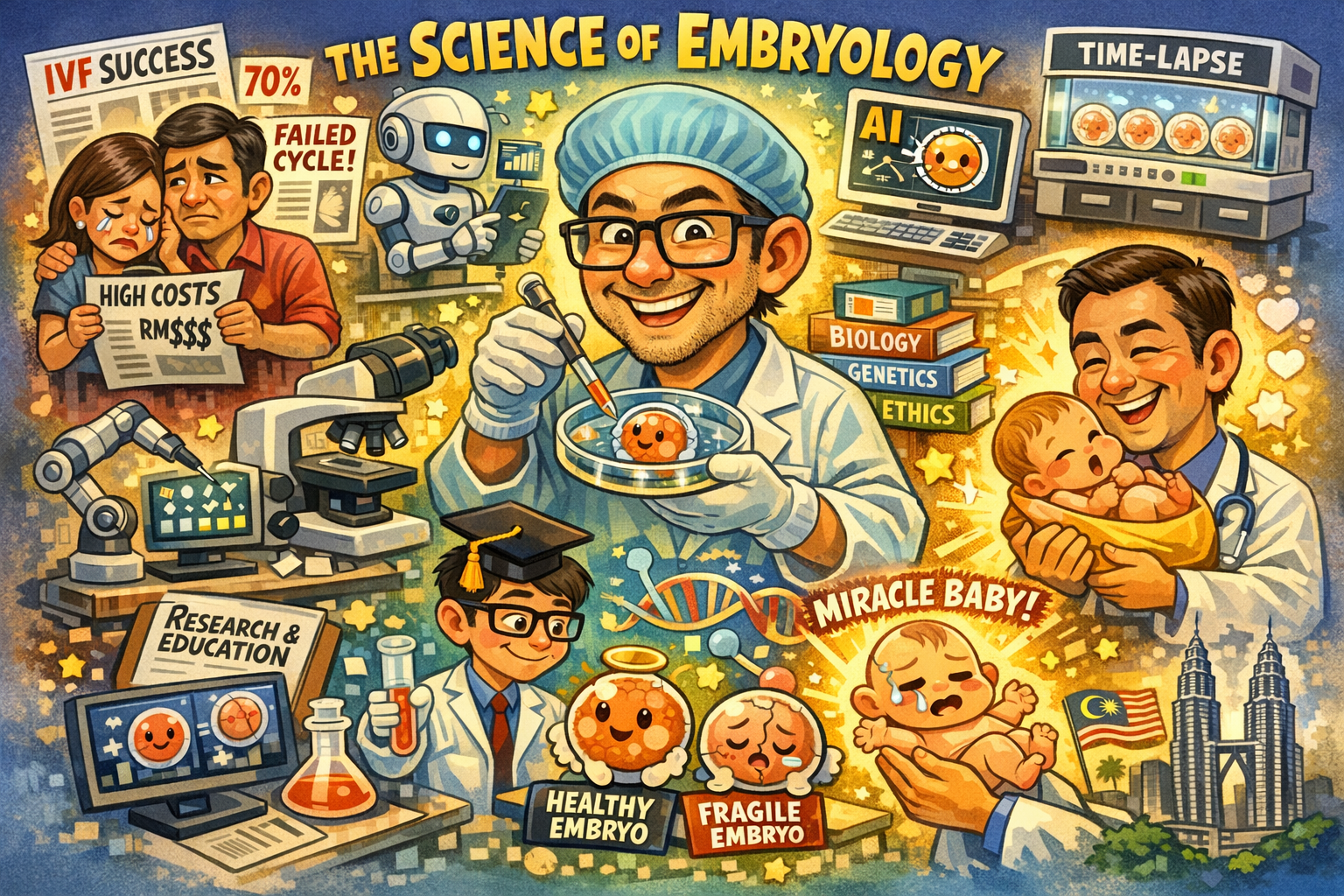
When Malaysians talk about In Vitro Fertilisation (IVF), the conversation is often emotional, and understandably so. Discussions frequently centre on high costs, long waiting periods, dashed hopes and, sometimes, miracle endings. Headlines tend to focus on clinics, doctors and success rates, turning IVF into a numbers game measured in percentages and price tags.
But long before a pregnancy test is taken, embryology plays a decisive role in determining the success or failure of every IVF cycle. Outcomes depend not only on clinical skill or advanced technology, but on how well the earliest stages of human development are understood.
Embryology is the science of how eggs mature, how embryos divide, and how delicate biological signals determine whether an embryo thrives or fails. Yet in public conversations, this scientific backbone of IVF is rarely acknowledged. Outcomes are discussed, but not the knowledge that makes those outcomes possible.
As demand for IVF rises in Malaysia and globally, this blind spot matters more than ever.
IVF is Growing Fast
Globally, infertility affects around one in six people of reproductive age, and the World Health Organisation recognises it as a disease, not a lifestyle choice.[1] In Malaysia, recent initiatives to expand subfertility care reflect a growing national commitment to supporting families.[2]
At the same time, fertility centres are rapidly adopting new technologies. Artificial Intelligence (AI) is used to assist embryo selection, time-lapse cameras track embryo development, and laboratories are becoming increasingly automated and data-driven. These tools promise greater efficiency and improved outcomes.
However, technology alone does not guarantee better fertility care. AI systems do not understand embryos. Cameras cannot explain why two embryos that appear identical behave very differently. Data dashboards do not replace biological insight.
In IVF, more data does not always lead to better decisions. Interpreting that data requires scientific judgement rooted in developmental biology. Without strong training in embryology, there is a real risk of over-relying on automated outputs without fully understanding their limitations. This can affect success rates, patient safety and ethical standards.
More Than a Lab Role
Many people assume embryologists simply follow technical procedures in a laboratory. In reality, embryology is a scientific field built on research.
Not all embryos that appear healthy are biologically the same. Many risks are invisible to microscopes or algorithms. Subtle molecular changes, environmental stress within the laboratory, and genetic variation can influence outcomes in ways technology cannot always detect. These nuances are understood through research, not protocols alone.
As fertility care evolves, centres increasingly need professionals who can evaluate new technologies, question assumptions, and translate scientific evidence into safe, effective clinical practice. Progress in IVF depends not just on adopting innovation, but on knowing when, how and why to use it responsibly.
Why Universities Matter
This is where higher education quietly shapes the future of fertility care. Embryology education is not about producing laboratory technicians overnight. It trains embryology scientists with strong foundations in developmental biology, molecular science, data analysis, experimental design and bioethics.
Graduates are not limited to IVF laboratories. With the right training and exposure, they contribute to the development of improved culture systems, laboratory equipment, digital platforms, diagnostic tools and decision-support software that raise standards across the fertility industry. They also play and important role in shaping how IVF is regulated.
As fertility technologies advance faster than legislation, countries with strong academic expertise are better equipped to develop policies that balance innovation, ethics, patient safety and societal values. Malaysia’s ambition to strengthen its fertility ecosystem depends not only on expanding services, but on cultivating local scientific expertise that can guide national standards and public debate.
Knowledge Builds Families
The future of fertility care will not be decided solely inside IVF clinics. It will be shaped in research laboratories, classrooms and collaborations between universities and industry.
Investing in embryology education builds a local talent pipeline, reduces dependence on imported expertise, and strengthens long-term resilience in the fertility sector. For industry, this means access to scientists who can drive innovation responsibly. For patients, it means care grounded in evidence, ethics and deep biological understanding.
For students considering careers in health sciences, biology or human development, embryology offers more than a job. It offers an opportunity to contribute meaningfully to one of the most impactful areas of modern healthcare.
IVF may capture headlines, but embryology shapes outcomes. If fertility care in Malaysia is to improve in a meaningful and sustainable way, this vital science must be brought out of the shadows and into the national conversation.
Dr Adeline Chia is the Head of School of Biosciences and an Associate Professor, and Dr Lee Sau Har is the Programme Director of the Bachelor of Applied Health Sciences (Honours) and a Senior Lecturer at the School of Biosciences, Faculty of Health and Medical Sciences, Taylor’s University.
Ms Khairunnisa’ Esa is the General Manager and Director at LabIVF (M) Sdn Bhd, and a member of the Industry Advisory Panel for the programme.
[1] https://www.who.int/news/item/04-04-2023-1-in-6-people-globally-affected-by-infertility
[2] https://www.nst.com.my/news/nation/2025/11/1322866/falling-birth-rate-caused-financial-constraints-difficulty-finding