
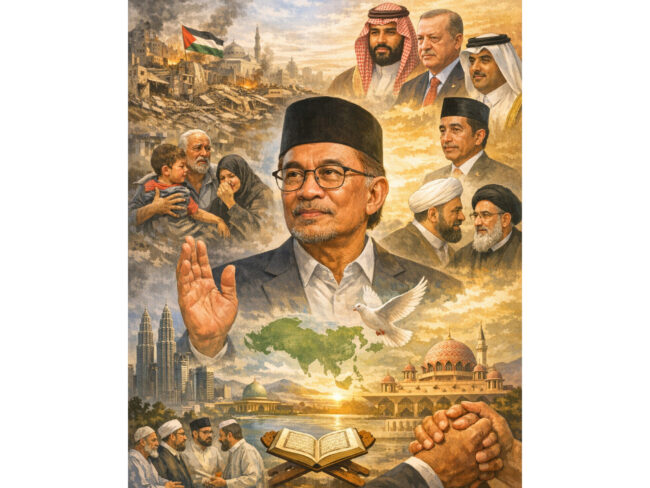
A new dawn for the ummah: Why Anwar Ibrahim must lead the post war muslim reconciliation
By DR MASZLEE MALIK
The Muslim world has emerged from yet another season of destruction.
In the aftermath of war, the familiar ritual unfolds: cities reduced to rubble, fragile ceasefires proclaimed, and weary populations left to reconstruct lives amid ruins.
Yet the most devastating consequences are rarely physical alone. They are civilisational.
Every conflict in the Muslim world exposes once more a deeper ailment, namely the persistent fragmentation of the Ummah itself.
Iran, Palestine, Syria and Yemen have all, in different ways, become theatres of a tragedy whose roots lie not merely in geopolitics but in disunity.
The Ummah today numbers almost two billion people across more than fifty states.
It commands nearly a quarter of the world’s population and occupies territories rich in energy, maritime routes and strategic geography.
The Muslim world collectively produces roughly eight trillion US dollars in GDP and controls the bulk of global oil reserves.
Yet despite this immense demographic and material potential, it remains politically marginal and strategically fragmented.
The paradox is striking. A civilisation so vast should not be so vulnerable.
The reason lies partly in external pressures and great power rivalries, but also in a failure of internal reconciliation.
Sectarian antagonism between Sunni and Shia has become one of the most corrosive forces undermining Muslim solidarity.
What began as theological divergence centuries ago has been repeatedly instrumentalised in modern times as a geopolitical tool.
In the process, differences that once existed within the broad house of Islam have been hardened into rigid political fault lines.
The consequences are measurable. According to the Armed Conflict Location and Event Data Project, conflicts involving Muslim majority regions have accounted for a significant proportion of global battle related fatalities in the past two decades.
Meanwhile, economic integration among Muslim countries remains far below potential.
Intra Organisation of Islamic Cooperation trade, for instance, accounts for only around twenty percent of member states’ total trade flows, far lower than the levels of economic integration achieved within the European Union or East Asia.
In other words, the Ummah possesses immense capacity but insufficient cohesion.
Yet history teaches that moments of crisis often contain within them the seeds of renewal.
Wars exhaust ideologies. They expose the limits of confrontation and create openings for reconciliation.
The present moment therefore invites a question that is at once political and philosophical: who possesses the moral authority to lead such a reconciliation?
My contention is that Malaysia’s Prime Minister, Dato Seri Anwar Ibrahim, stands uniquely positioned to play such a role.
This assertion may appear unconventional. Southeast Asia is geographically distant from the traditional centres of Muslim political power in the Middle East.
Yet leadership in the Muslim world has never been solely determined by geography.
It has been determined by moral credibility, intellectual depth and the capacity to inspire trust across ideological divides.
Anwar Ibrahim embodies a political biography that few contemporary leaders can rival in this regard.
His journey began not within the corridors of state power but within the currents of Islamic revivalism that swept across the Muslim world during the latter half of the twentieth century.
As a founder of the Angkatan Belia Islam Malaysia in the early 1970s, he emerged as one of Southeast Asia’s most prominent voices for Islamic renewal and social justice.
The movement itself was deeply influenced by anti colonial thought, by Muslim intellectual traditions and by the wider awakening that followed events such as the Iranian Revolution of 1979.
Indeed, Anwar’s intellectual curiosity led him to engage with diverse strands of Islamic thought, including those emerging from Iran.
At a time when sectarian suspicion often discouraged such engagement, his willingness to listen and learn reflected a disposition toward dialogue rather than exclusion.
That intellectual openness would later become one of his defining political attributes.
Yet biography alone does not produce moral authority. It is suffering that often refines leadership.
Few leaders in the Muslim world have endured persecution as Anwar Ibrahim has.
His imprisonment in 1998 following the political upheavals of Malaysia’s reform movement remains one of the most defining episodes in contemporary Malaysian history.
Images of the then deputy prime minister appearing in court with a bruised and blackened eye became symbols of political repression that reverberated across Asia.
Over the course of nearly a decade spent in prison across two separate periods, Anwar confronted the harsh realities of political power stripped of justice.
Yet what is remarkable is not merely that he endured imprisonment but that he emerged from it without succumbing to bitterness.
Instead, he returned to public life advocating democratic reform, institutional accountability and national reconciliation.
Such moral resilience evokes a deeper ethical archetype within the Islamic tradition.
The Qur’anic narrative of Prophet Yusuf reminds believers that injustice and patience can coexist within a divine moral drama in which perseverance ultimately leads to redemption.
Leadership in Islam has never been measured solely by power but by sabr, by steadfastness in the face of adversity.
It is this moral dimension that distinguishes Anwar Ibrahim from many of his contemporaries.
In the contemporary geopolitical landscape the Muslim world is increasingly shaped by several influential centres of power. Saudi Arabia remains the custodian of Islam’s holiest sites and commands immense economic influence.
Turkiye projects a confident political identity bridging Europe and Asia. Qatar has established itself as a diplomatic mediator with global reach.
Pakistan represents a nuclear armed Muslim state with profound strategic significance. Indonesia, with over 240 million Muslims, constitutes the largest Muslim population on earth.
Each of these actors possesses its own interests and historical perspectives. Yet what has often been lacking is a figure capable of convening them within a framework of trust.
Anwar Ibrahim may well be that figure.
Since assuming office in 2022, he has undertaken an active diplomatic agenda engaging many of these leaders.
His meetings with President Recep Tayyip Erdogan, Crown Prince Mohammed bin Salman, Emir Tamim bin Hamad Al Thani and President Prabowo Subianto illustrate an emerging network of political relationships that cut across ideological lines.
Malaysia’s foreign policy under his leadership has sought to balance principled advocacy, particularly for Palestine, with pragmatic engagement across the Muslim world.
Malaysia itself offers a compelling model. It is a Muslim majority nation that has historically managed a pluralistic society comprising Muslims, Buddhists, Christians, Hindus and others within a democratic framework.
While not without its challenges, the Malaysian experience demonstrates that Islamic identity and multicultural governance are not mutually exclusive.
This experience has informed Anwar’s philosophical vision articulated through the concept of Malaysia Madani. The term signifies more than administrative reform.
It draws upon the classical Islamic notion of civilisation as a moral project grounded in justice, knowledge and compassion.
In contemporary intellectual discourse, scholars such as Asef Bayat have described the emergence of what they term post Islamism.
This concept reflects a shift from ideological Islamism toward a synthesis of religious values with democratic freedoms and civil rights. Anwar Ibrahim’s intellectual trajectory mirrors this evolution.
His political philosophy no longer frames Islam primarily as an instrument of ideological mobilisation but as a moral foundation for inclusive governance.
Such a perspective may prove particularly relevant in an increasingly multipolar world.
The global order that dominated the late twentieth century is undergoing profound transformation.
Western hegemony is no longer uncontested. Rising powers across Asia, Africa and the Middle East are reshaping international relations.
Within this emerging order, the Muslim world faces a critical choice. It can remain trapped within cycles of internal rivalry and sectarian distrust, or it can rediscover a shared civilisational confidence grounded in cooperation.
Reconciliation between Sunni and Shia communities is central to that endeavour. Theological differences will undoubtedly persist.
Yet history reminds us that Islamic civilisation flourished for centuries despite such differences.
Scholars from diverse schools debated vigorously while still recognising one another as part of a broader intellectual tradition.
The transformation of theological diversity into geopolitical hostility is therefore neither inevitable nor historically necessary.
What is required is leadership capable of reframing the discourse.
Rather than asking which sect represents the correct orthodoxy, the more urgent question concerns how the Muslim world can collectively address the injustices confronting its people.
From the tragedy of Gaza to the humanitarian crises of Yemen and Syria, the Ummah faces challenges that transcend sectarian labels.
Anwar Ibrahim’s credibility across ideological and regional boundaries positions him to initiate precisely such a reframing.
The task ahead would not be simple. It would require convening leaders whose national interests do not always converge.
It would require delicate diplomacy capable of acknowledging historical grievances while encouraging future cooperation.
It would also demand intellectual leadership capable of articulating a narrative of Muslim unity rooted not in uniformity but in ethical solidarity.
Yet moments of historical transition often call forth unexpected actors.
Southeast Asia, long considered peripheral to Middle Eastern geopolitics, may in fact offer precisely the neutrality required to facilitate dialogue.
Malaysia stands at the crossroads of the Indian Ocean and the Pacific.
Its history reflects centuries of interaction between Arab, Persian, Indian and Southeast Asian civilisations. In that sense it represents a microcosm of the wider Muslim world’s diversity.
For this reason, a reconciliation initiative led from Kuala Lumpur may possess a symbolic power that initiatives emerging from rival regional powers lack.
The ultimate objective should not be the construction of a monolithic political bloc. The Muslim world is far too diverse for such a vision.
Rather, the aim should be to cultivate a renewed consciousness of shared responsibility. A civilisational ethos in which disagreements remain possible but hostility becomes unnecessary.
Such an ethos would enable deeper economic collaboration, stronger educational exchanges and a more coherent diplomatic voice on issues affecting Muslim communities globally.
History rarely grants second chances. Yet the aftermath of war occasionally opens a narrow window through which renewal becomes possible.
The Muslim world stands today at such a threshold.
If the twentieth century was marked by ideological polarisation and geopolitical fragmentation, the twenty first century could yet witness a rediscovery of civilisational confidence grounded in dialogue, knowledge and justice.
For that possibility to materialise, leadership will be essential.
In this moment, few figures embody the moral credibility, intellectual maturity and political experience required for such leadership as Anwar Ibrahim.
Should he choose to assume this role, he would not merely be advancing Malaysia’s diplomatic profile. He would be helping to restore a deeper ideal within the Islamic tradition itself.
An ideal that the Qur’an expresses with profound simplicity: that believers are but a single community, entrusted with the responsibility of upholding justice among humankind.
The time has come for the Ummah to rediscover that unity. And perhaps, in this new chapter of history, Malaysia may help illuminate the path forward.
Prof Dr Maszlee Malik was Education Minister from 2018 to 2020 and is now chairman of the International Institute of Advanced Islamic Studies (IAIS) Malaysia.
ALSO READ Muda heads into chaotic party polls