
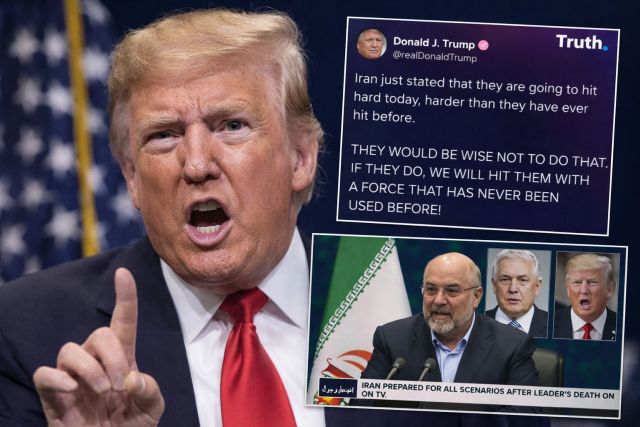
Unfit to lead: The moral and cognitive collapse of Donald Trump
By MASZSYUHADA MASZRI
The American story is defined by the slow, often painful expansion of the “we” in “We, the People.” From the 13th Amendment’s abolition of slavery to the 19th’s guarantee of women’s suffrage, the American constitutional history is a record of marginalized groups — indigenous peoples and people of colour — fighting to turn the document’s hollow promises into lived realities. Yet, history warns us that progress is not linear.
For every leap forward in civil rights, there are moments where the executive branch threatens to pull the republic backward into chaos. Today, Americans find themselves in such a moment, where the constitutional tools once used to expand liberty must now be used to preserve the very structure of their government.
The current crisis surrounds Donald Trump and has moved beyond mere political polarization. It has become a question of fundamental presidential fitness.
Politicians such as Senator Chris Murphy and Senator Chuck Schumer have led the calls for his removal, labeling him an “unhinged madman” for his role in the ongoing atrocities against Iran. Central to this alarm is the administration’s complicity with Israel—the main perpetrator of the current regional violence. When a President’s decision-making appears dictated by outside interests or erratic impulses rather than the sober defense of the republic, the question is no longer one of policy, but of capacity.
The 25th Amendment functions as a vital constitutional emergency valve, allowing for the immediate removal of a president who is “unable to discharge the powers and duties” of the office, but it is a temporary fix for a much deeper systemic rot. While Section 4 can theoretically halt the impulses of an “unhinged” leader, it offers no long-term guarantee against the continued perpetration of global atrocities by American politicians.
The reality remains that simply replacing the figurehead does little to dismantle the structural forces, specifically the entrenched influence of AIPAC — that dictate Washington’s complicity in regional violence. In this tough political landscape, the amendment might provide a mechanism to remove a single unfit individual, but it cannot, on its own, purge the lobbying interests that have historically steered American foreign policy toward catastrophe.
The argument for presidential unfitness is further solidified by the administration’s domestic maneuvers, where the aggressive expansion of Immigration and Customs Enforcement (ICE) has moved from policy enforcement to systemic overreach. The passage of the “ One Big Beautiful Bill (OBBBA) in 2025 essentially supercharged this agenda, diverting nearly $170 billion toward a militarized domestic force.
This surge in funding facilitated “Operation Metro Surge” an unprecedented deployment of agents in metropolitan areas like Minneapolis-Saint Paul. Characterized by the use of masked agents and unmarked vehicles, this operation has fundamentally disrupted American civil society, resulting in the tragic deaths of U.S. citizens and the erosion of due process.
The volatility of this approach is most starkly illustrated by its impact on Native American communities. In a bitter historical irony, Indigenous citizens — individuals whose ancestors were here long before the current borders were drawn have been racially profiled and detained by ICE agents under broadened enforcement mandates.
Reports of tribal citizens being forced to carry specialized identification to prove their right to exist in their own communities highlight a profound failure to honor treaty responsibilities and basic constitutional rights. When the executive branch deploys a multi-billion dollar force that fails to distinguish between foreign nationals and the continent’s original inhabitants, it demonstrates a level of administrative incompetence that renders it unfit to lead a diverse republic.
Furthermore, this degradation of domestic civil rights coincides with a profound crisis of personal moral legitimacy. Recent disclosures from the “Epstein files” released in 2026 under the Epstein Files Transparency Act —contain deeply disturbing allegations and FBI memos detailing claims of sexual abuse.
While the administration dismisses these as “unfounded,” the sheer volume of newly public documents linking Trump to a network of systemic predation creates an ethical vacuum.
This is not a crisis hidden by partisan spin; the global community is not blinded. From domestic critics to international observers, there is a clear-eyed awareness that these records prove a fundamental moral disqualification. When an executive is embroiled in notorious sadistic acts while state-sanctioned mistreatment targets vulnerable populations at home, they lose the authority to represent the United States.
How can a so-called “first-world” superpower maintain its global standing when the cognitive and moral foundations of its leadership have so visibly crumbled? The alarm has moved beyond the usual political opposition; by April 2026, even MAGA dissidents have begun to publicly scrutinize the President’s mental capacity, signaling that the threat of erratic decision-making now transcends party lines.
This internal instability poses a direct peril to the global economic and geopolitical order, especially as the administration appears increasingly steered by Israeli interests rather than a sober defense of the republic. When the incapacity of a single individual can impact the entire world — essentially leading Trump by the nose like a bull toward catastrophe — the question of presidential fitness is no longer just a domestic concern; it is a global necessity.
- Maszsyuhada Maszri is a Research Associate at the International Institute of Advanced Islamic Studies (IAIS) Malaysia.