
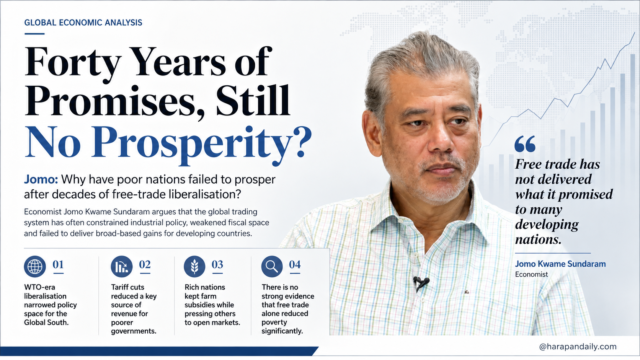
Forty years of promised prosperity: Why are poor nations still falling behind, asks Jomo
Four decades after trade liberalisation became the cornerstone of the global economic order, many developing countries remain trapped in poverty, raising fundamental questions over whether the model has delivered on its promise of shared prosperity.
Veteran economist Prof Dr Jomo Kwame Sundaram argues that while US President Donald Trump has blamed globalisation for America’s industrial decline, the deeper failure lies in a global trading system that has never benefited all countries equally.
In his latest commentary, Jomo said Trump’s “America First” agenda does not offer a meaningful alternative. Instead, it replaces one flawed approach with another by using tariffs, investment leverage and economic coercion to advance US commercial interests at the expense of allies and developing economies.
“Rather than restoring global growth, these policies are slowing the world economy, including that of the United States itself,” he said.
According to Jomo, trade liberalisation, championed under the Washington Consensus from the 1980s onwards, was promoted as a pathway to higher growth, rising incomes and job creation. Instead, he said, the neoliberal era has been marked by slower and more volatile global growth than the post-war Keynesian period.
He noted that the establishment of the World Trade Organization (WTO) through the 1994 Marrakesh Agreement significantly narrowed the policy space available for developing countries to pursue their own industrialisation strategies.
While the WTO was intended to strengthen a rules-based trading system, Jomo argued that the US has increasingly undermined the institution whenever it no longer served American interests.
He pointed to Washington’s move to block appointments to the WTO Appellate Body since the Obama administration, effectively paralysing the organisation’s dispute settlement mechanism.
“The rules-based system has been weakened precisely because major powers no longer accept rules that constrain their own interests,” he said.
Jomo also challenged the long-held assumption that freer trade naturally leads to industrial development.
Instead, he argued that partial and uneven trade liberalisation has contributed to premature deindustrialisation across many developing economies, particularly in Africa, where manufacturing remains limited to basic import substitution and resource processing.
He added that trade preferences and selective concessions granted by advanced economies have often divided developing countries, weakening their collective bargaining position in multilateral negotiations.
Another consequence, according to Jomo, has been the erosion of fiscal capacity in poorer countries.
Trade liberalisation significantly reduced tariff revenues, which had historically accounted for a substantial share of government income in many low-income economies. Alternative sources of revenue, such as consumption and income taxes, have failed to fully compensate for these losses, leaving governments increasingly dependent on borrowing.
The agricultural sector presents a similar picture.
Jomo said developing countries have long sought the removal of agricultural subsidies and import barriers maintained by advanced economies. However, such reforms have been resisted unless poorer nations first dismantle protections for their own manufacturing sectors.
At the same time, structural adjustment programmes weakened agricultural infrastructure and support systems for smallholder farmers across much of the developing world.
Questioning the widely cited benefits of trade liberalisation, Jomo said many projected gains remain theoretical, relying on assumptions that developing economies already possess internationally competitive industries capable of responding to new market opportunities.
“In reality, those productive capacities must first be built, often through carefully designed industrial and trade policies,” he argued.
He cited studies conducted during the WTO Doha Round negotiations, including those commissioned by the World Bank, which projected net losses for most developing countries, with only a handful of Asian economies expected to benefit.
“There is also little robust evidence that trade liberalisation has significantly reduced poverty or hunger,” Jomo said.
“If liberalisation genuinely serves the interests of developing countries, one has to ask why they need to be persuaded through initiatives such as ‘Aid for Trade’.”
Ultimately, he warned that decades of liberalisation have substantially narrowed the policy options available to aspiring developmental states.
By restricting governments’ ability to formulate industrial, investment, technology and trade policies, Jomo argued that the prevailing global trade regime has made sustainable and inclusive development increasingly difficult for many of the world’s poorest economies.
READ MORE RCI Tabung Haji: MACC arrests former CEO, CFO over RM370mil share acquisition