
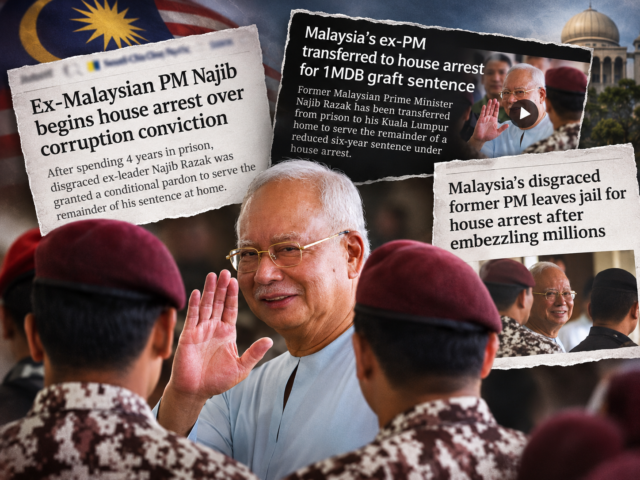
International media describe Najib as ‘disgraced former PM’ as house arrests makes global headlines
Former Malaysian Prime Minister Datuk Seri Najib Razak’s move from prison to house arrest has attracted international attention, with major news organisations including The New York Times, BBC and Al Jazeera highlighting his criminal convictions and the multibillion-dollar 1Malaysia Development Berhad (1MDB) scandal.
Rather than focusing solely on the royal clemency that allowed Najib to serve the remainder of his SRC International sentence at home, international media reports also revisited the corruption scandal that damaged his political career and drew worldwide scrutiny.
The New York Times carried the headline, “Disgraced Former Malaysian Prime Minister Released to House Arrest”, describing Najib as a disgraced former leader while reporting his release from prison to serve the remainder of his sentence at his residence.
In its November 10 report, the influential American newspaper linked Najib’s political downfall to the multibillion-dollar 1MDB scandal, reminding international readers of the controversy that had previously placed Malaysia under intense global scrutiny.
The BBC adopted an even more direct headline: “Malaysia’s disgraced former PM leaves jail for house arrest after embezzling millions”, explicitly connecting Najib’s latest legal development with the financial crimes for which he was convicted.
Al Jazeera, meanwhile, reported the development under the headline “Malaysia’s Najib moved from prison to house arrest after royal clemency”, emphasising the royal pardon process while also recalling Najib’s imprisonment and the wider 1MDB controversy.
Legal implications
International news agencies Reuters and Associated Press also covered the developments, examining the court proceedings, the RM50 million fine payment and the legal implications of Najib’s separate 1MDB sentence.
Reuters highlighted an important distinction in its coverage: although Najib was permitted to return to his residence, he was not a free man.
House arrest remains a form of punishment, rather than an acquittal or the cancellation of his criminal conviction.
The international coverage also followed the legal controversy surrounding the original court order issued on November 6, which prompted the Attorney General’s Chambers to seek clarification. The High Court subsequently replaced that order with a new one on November 10.
Under the revised order, Najib is required to serve the remainder of his SRC International sentence under house arrest until August 23, 2028. His separate 15-year prison sentence in the 1MDB case remains subject to the legal appeal process.
Najib has consistently denied wrongdoing and maintained that he was made a scapegoat in the 1MDB scandal. Nevertheless, his criminal convictions remain central to how international news organisations present his political and legal history.
The contrast between domestic and international coverage is particularly striking. While debate within Malaysia has largely focused on royal clemency, constitutional procedures and the Attorney General’s role, international reporting continues to place Najib’s house arrest within the broader context of corruption, accountability and the 1MDB scandal.
For Najib’s supporters, the move to house arrest may represent a significant personal and political development.
However, the headlines published by some of the world’s most prominent news organisations demonstrate that the legacy of 1MDB continues to follow the former prime minister.
Ultimately, the issue extends beyond where Najib serves his sentence. It also raises wider questions about international perceptions of Malaysia’s justice system, the principle of equality before the law and the country’s continuing efforts to strengthen public confidence in its institutions.
For the international audience, Najib’s return home has not erased the story of 1MDB. It has brought that story back into the global headlines.