

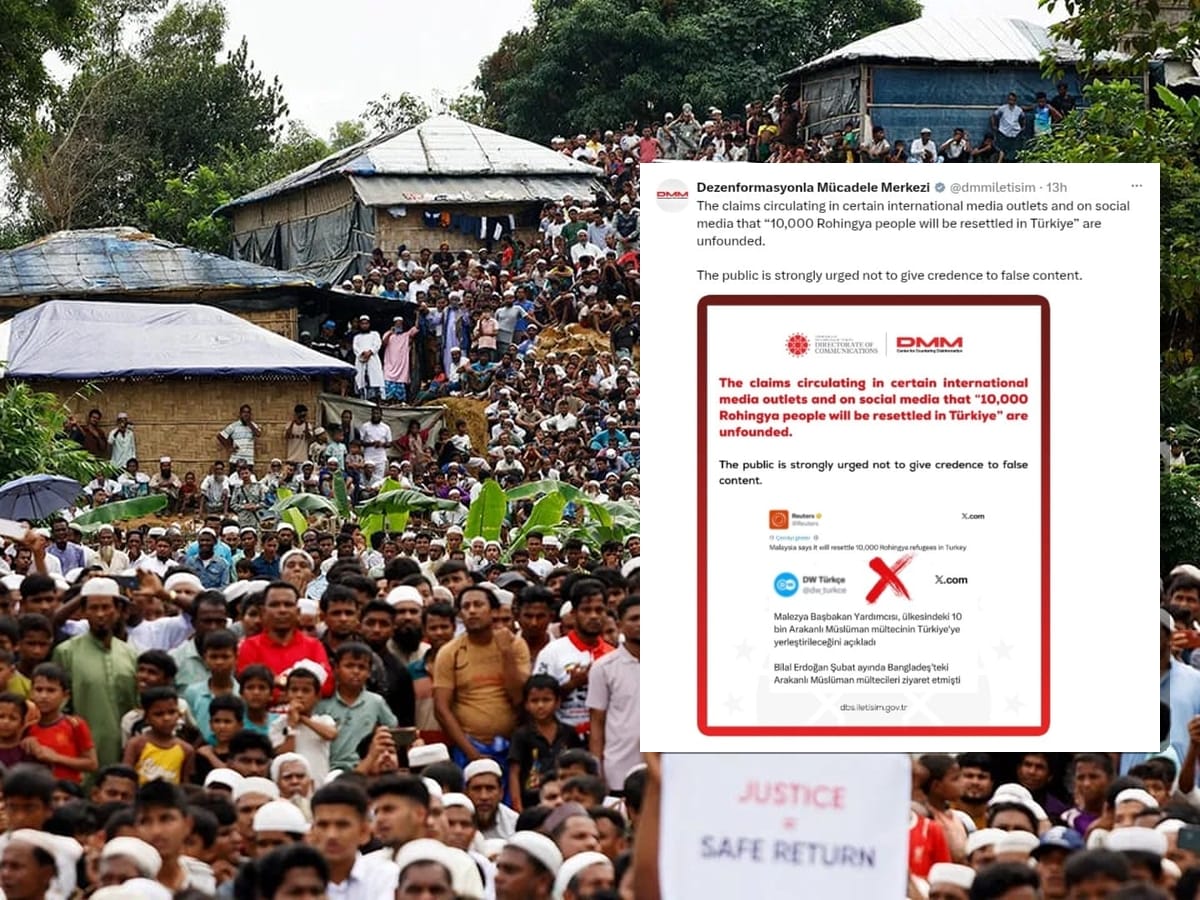
Turkey denies Zahid’s claim, Turkish politician speaks out on 10,000 refugess issue
The controversy surrounding Deputy Prime Minister Datuk Seri Ahmad Zahid Hamidi’s claim that Turkey had agreed to accept 10,000 Rohingya refugees from Malaysia has taken another turn, with a video featuring a Turkish politician now attracting attention among Malaysian social media users.
The video, featuring Selçuk Türkoğlu, a politician from Turkey’s İYİ Party (Good Party), was shared on Threads by user arifdanial427, who linked the politician’s criticism of refugee arrivals to the controversy involving Zahid.
In the video, accompanied by a Malay translation, Türkoğlu reportedly questioned the arrival of 10,000 people and its potential consequences for Turkey’s future.
“What is happening here? Did these 10,000 migrants also appear through some kind of lucky draw? Are you so hostile towards the Turkish homeland, which has existed for a thousand years?” read part of the translation shared on Threads.
The Turkish politician also questioned whether the country’s immigration policies were increasingly turning Turkey into a destination for refugees at the expense of its own citizens.
However, it has not been independently established whether Türkoğlu’s remarks were specifically directed at Zahid’s proposal or concerned a separate domestic debate over refugees in Turkey.
Nevertheless, the video has attracted attention among Malaysian social media users, particularly after it was linked to the controversy surrounding Zahid’s announcement.
The Threads user who shared the video openly criticised the Deputy Prime Minister, describing the episode as an embarrassment to Malaysia.
“This time, Wak Komedi47 has really caused trouble! What an embarrassment to Malaysia. Poor PMX, working tirelessly around the clock to enhance the country’s reputation,” the user wrote in Malay.
The remarks reflected the user’s frustration over a controversy unfolding while Prime Minister Datuk Seri Anwar Ibrahim continues his efforts to strengthen Malaysia’s diplomatic relationships and international standing.
The controversy began on November 20 when Zahid reportedly announced that Turkey had agreed to accept 10,000 Rohingya refugees from Malaysia through a Technical and Vocational Education and Training (TVET) programme.
However, Turkish authorities subsequently rejected the claim that such an agreement had been reached, raising questions about the actual status of the proposal.
Following the denial, Zahid’s press secretary issued a clarification, explaining that the proposal was still undergoing coordination and had not been finalised.
The clarification highlighted a significant distinction between a proposal under discussion and a formal agreement reached between two governments.
The episode has consequently raised an important question: Why was a proposal that had yet to be finalised communicated in a manner that created the impression that an agreement had already been secured?
The issue is particularly sensitive because it involves Rohingya refugees, Malaysia–Turkey diplomatic relations and the immigration policies of a sovereign nation.
Although there is no verified evidence that Türkoğlu’s video was a direct response to Zahid, its circulation among Malaysian social media users illustrates how the controversy has become associated with Turkey’s wider political debate over refugees.
The incident has also raised broader questions about the accuracy and coordination of official communications involving foreign governments.
At a time when Anwar is seeking to strengthen international confidence in Malaysia, controversies arising from potentially premature diplomatic announcements risk creating unnecessary confusion.
Diplomatic credibility depends not only on maintaining strong bilateral relationships but also on ensuring that public statements accurately reflect the status of negotiations and agreements.
For Malaysia, the controversy is therefore about more than the proposed relocation of 10,000 Rohingya refugees. It also concerns the importance of clarity, accountability and credibility in government communications.
The central question now is not merely whether the refugees will eventually be relocated to Turkey, but how the impression of a confirmed agreement emerged before the proposal had been formally concluded.
Until both governments provide further clarification, the episode is likely to remain a subject of political debate and public scrutiny.